Home

MAXIMIZING AND PRESERVING CAPITAL GROWTH

Maximizing long‑term returns is essential for building wealth and achieving financial independence. Most growth‑oriented strategies require time to smooth out market volatility and capture compounding gains

Managing the tension between risk and reward—pursuing opportunity while guarding against loss—is a constant discipline. Ignoring risk can lead to significant setbacks

Conservative portfolios that prioritize capital preservation typically generate annual returns of 2% to 5%. Balanced portfolios, which take on moderate risk to enhance growth while maintaining stability, generally produce returns in the 5% to 6% range

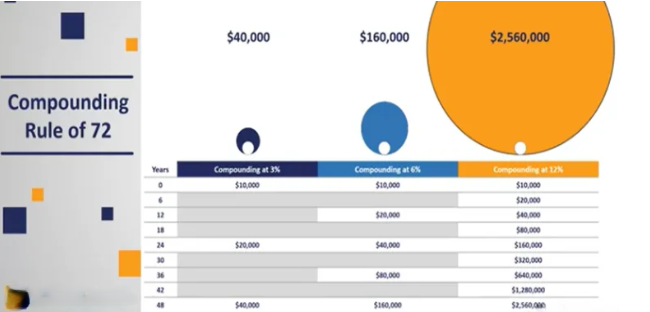
Imagine an asset class delivering a consistent 12% annual historical growth rate with near‑zero risk exposure. The impact of higher returns becomes striking when you model compounding over multiple years

Using the Rule of 72, you can estimate doubling time by dividing 72 by the annual return. A 3% return doubles in 24 years, 6% in 12 years, and 12% in 6 years. The compounding gap widens sharply as rates increase. If a near‑zero‑risk strategy produced 12% annually, the long‑term lifestyle impact would be substantial

Flexmethod is a long‑horizon capital‑growth framework built around a permanent life insurance policy engineered with additional growth mechanisms. Beyond the death benefit, it offers living benefits, tax‑free accumulation and access, and effectively no savings caps or penalties

Permanent life insurance is recognized by banks as a Tier‑1 Asset—one of the safest balance‑sheet holdings available. Flexmethod structures use fixed and indexed crediting strategies that capture market upside without exposure to market downturns

Although future performance cannot be predicted, the indexed illustrations below reflect more than 100 years of historical market behavior, interest‑crediting patterns, and economic cycles—including recessions, depressions, wars, pandemics, and housing crashes. Over extended periods, indexed policies have delivered tax‑advantaged returns averaging 11%–16%

Retirement planning typically moves through two major stages:

1. Accumulation: This is the growth phase, where you’re actively saving and investing. The goal is to build wealth, often by pursuing higher returns and accepting more risk while there’s still time to rebound from market swings

2. Capital Preservation: As retirement approaches, the focus shifts from growth to protection. The priority becomes stability, lower‑risk investments, and reliable income so your savings last as long as you need them

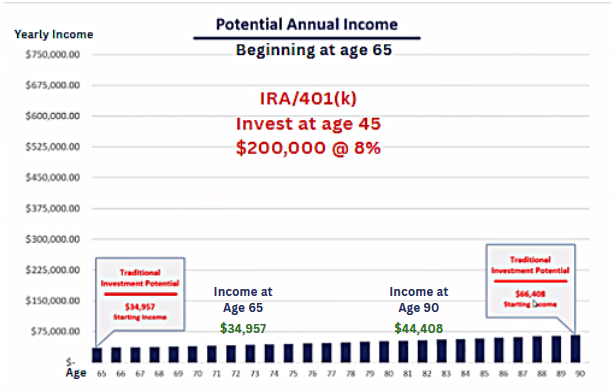
Once you reach the protection stage, the effect of conservative returns—like 5%—on your retirement income becomes clear in the example below

*For Illustrative Purposes Only*

See Below

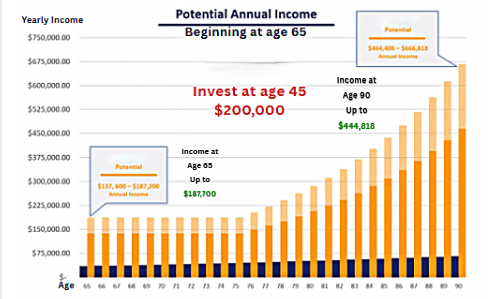
Below, you’ll see a comparison between a traditional IRA/401(k) earning 8% until retirement and 5% thereafter, and a Flexmethod plan earning 11%–16% throughout both phases. The resulting income gap—$187K annually versus $35K—illustrates how dramatically return rates shape retirement outcomes

Corporate Flexmethod structures allow employers to tackle three persistent financial pressures: benefit expenses, key‑employee retention, and overall tax load. By reallocating dormant cash reserves—typically held in low‑yield accounts for contingencies or future projects—into a secure, liquid Tier‑1‑quality asset, companies gain access to higher growth rates and enhanced tax efficiency

The resulting gains can strengthen profitability, improve working‑capital management, or be applied to offset employee‑benefit costs, including healthcare, executive life insurance, and pension obligations

Historically, corporate Flexmethod implementations have generated long‑term, tax‑advantaged returns in the 14%–21% range, creating substantial income capacity over time

A Sample of a CorpFlex Plan for an Employee Benefit

*For Illustrative Purposes Only*

See Below

Sample Application: Turning a $100K policy into $2.7M of long‑term income

In this example, a $100K Flexmethod policy is established for an employee. After six years, the company can withdraw its original $100K contribution, while the remaining cash value—about $48K—is assigned to the employee. That amount compounds into an income benefit of roughly $72K annually by year 16, with continued increases thereafter

This structure functions as a cost‑neutral tool for executive retention. The policy transfer at year 6 is taxable to the employee, but all future policy loans/distributions are tax‑free. If the employee departs before year 6, they retain the permanent death benefit, and the company keeps the cash value and all future growth

Net cost to the business: $0. Long‑term value created: approximately $2.7M


A Sample of a CorpFlex Plan for an Employer Benefit

*For Illustrative Purposes Only*

See Below

In this illustration, a $100K CorpFlex policy enables the employer to start drawing roughly $26,000 per year beginning in year 6, with both income and cash value increasing over time. The entire outcome is generated from a $100K initial investment and can be scaled upward for larger corporate funding levels


Using Flexmethod To Pay $300K Mortgage & Create Retirement Income

*For Illustrative Purposes Only*

See Below

A 46‑year‑old invests in a $300K Flexmethod policy with a $1.9M death benefit

For the first 15 years, the policy generates $23,245 per year, enough to cover a $300K mortgage at 6.5%

In year 16, income jumps to $73K, creating more than $49K in extra annual cash flow

By year 25, income grows to $103K, and by year 30, it reaches $157K, with a $2.6M death benefit

By age 76, the policyholder has received over $1.1M in additional income—while the mortgage was fully paid using policy earnings


25-Year-Old Uses Flexmethod To Accelerate Mortgage Payoff & Create Retirement Income

*For Illustrative Purposes Only*

See Below

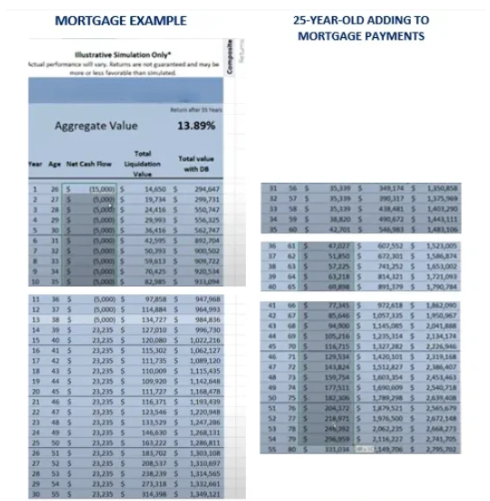
A 25‑year‑old takes out a $308K, 30‑year mortgage at 6.5% and purchases a $10,000 Flexmethod policy 

using funds normally kept in a bank for emergencies

For the first 13 years, the homeowner adds  $5,000 per year to the regular mortgage payments

 By year 14 (age 38), the policy’s income stream is strong enough to take over the remaining mortgage payments 

for the rest of the 30‑year term  

Once the mortgage is fully paid (year 31, age 56), the policy’s income continues and increases each year

Annual income from the policy:    Age 56: $35,000    Age 66: $77,000    Age 76: $204,000


What you could capture market gains while substantially minimizing exposure to market losses?

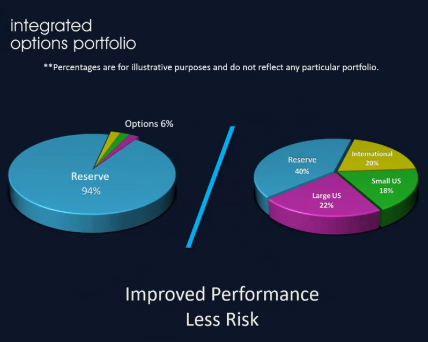
Flexmethod integrates with an Options‑Based Portfolio to allow full participation in market gains without exposing principal to market declines. Rather than buying shares outright in the higher‑volatility segments, the portfolio uses call or put options that provide directional exposure with limited downside. The Reserve segment—earning 11%–16% annually—helps fund option premiums and stabilizes overall performance

If price movements align with expectations, the option can be exercised and the underlying shares sold at a profit. If not, the option expires with no further obligation

The enhanced Reserve yield dramatically increases strategic flexibility, enabling more frequent or longer‑dated option positions while still maintaining overall portfolio stability. Over time, the Reserve’s strong returns can offset option costs, smooth volatility, and materially increase total portfolio growth

*For Illustrative Purposes Only*

See Below

Flexmethod’s Giving Machine significantly enhances charitable outcomes. In the illustrated scenario, the charity receives 49% more than it would from a direct contribution, and the donor’s tax benefit also increases by 49%. With the addition of the policy’s death benefit, total charitable value rises by 184%, producing almost three times the impact of a standard donation


*For Illustrative Purposes Only*

See Below

A 5‑Star high‑school senior is being recruited by two elite football programs. School A presents a straightforward $1.5M signing bonus. School B structures the same $1.5M as a $500K immediate payment plus a $1M Flexmethod policy, generating the deferred income illustrated below. When compensation becomes the deciding factor, the long‑term income beginning at age 23 could materially shift the athlete’s choice


SCHOOL A – $1,500,000

One Time Payment


SCHOOL B – $500,000 Down Payment 

 $1,000,000 FLEXMETHOD POLICY

See results below

How do I know this is legitimate?

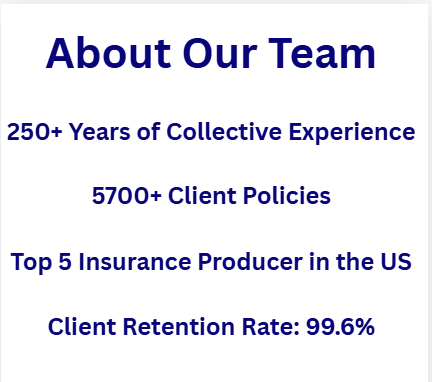
The FlexMethod has been around for over 10 years and has nearly 3000 clients.  We have been reviewed by legal teams, accounting firms, auditors, state and federal regulators, and insurance compliance departments.  There is nothing fabricated or exagerated

Is my money safe?

This is an insurance policy designed for maximum cash value.  Insurers are highly regulated and are required to carry vast reserve accounts.  In addition to reinsurance pools there are multiple other safeguards.  There is no other asset considered to be safer by bank regulators and institutional investors than cash value life insurance

About FM Team

Long‑term wealth creation can support many different financial priorities—some of which you see above. There is no one‑size‑fits‑all solution; every plan has its own objectives. We believe the Flexmethod strategy delivers a blend of aggressive growth and capital preservation that is difficult to match, regardless of the financial goal


If you’re comfortable sharing what matters most to you financially, we’ll use our experience and specialized resources to help design a plan that meets—and often exceeds—your objectives. Whether your focus is future savings, tax mitigation, legacy planning, business‑capital management, investing, or charitable giving, we welcome the opportunity to serve you


The process begins with a brief introductory call. From there, you decide whether you’d like to see customized examples aligned with your goals. We also encourage participation from your financial and tax advisors

Simply complete the form below to get started


Explore freely, decide confidently, no sales pressure ever

Submit
Name
Name
First
Last

                                                                                                                                                                                             Mark Twain

*Disclosure

  • By reviewing this design, you acknowledge and agree to the following:
    1.Conceptual Numbers – All values used in this design are conceptual and are not guaranteed by any party, including your agent, wealth consultant, any life insurance carrier, or US Life. These values are for illustrative purposes only.
    2.Non-Carrier Illustrated Figures – The figures presented in this design are not carrier-illustrated numbers. The Flexmethod is not an insurance product itself; rather, it incorporates insurance products into your overall financial strategy.
    3. Refer to Carrier Illustration – Before moving forward, you will be provided with a copy of the official policy illustration from the carrier. The carrier’s illustration will contain the detailed terms and conditions of your policy and should be referred to for accurate information regarding your policy.

    4.Indexed Universal Life Policy (IUL) Performance – If you are using an Indexed Universal Life (IUL) policy, its performance will be based on the returns from external indexes. This design simulates potential index performance but does not represent actual future returns. Actual returns may be more or less favorable than the assumptions used in this design.

    5.Borrowing Risks – Borrowing from an insurance policy introduces additional risks, including the possibility of the policy lapsing if the amount borrowed exceeds the surrender value. Borrowing may also affect or eliminate any guarantees provided by the insurance carrier. If your policy lapses, you will lose the death benefit and may incur tax liabilities on the borrowed amounts.

    6. Interest Rate Assumptions – The borrowing rates used in this illustration are assumed for simulation purposes and may differ from actual future rates. These rates are not guaranteed and will fluctuate over time. The actual borrowing rates could be more or less favorable than those shown in this design.
    7. Core Assumption – The Flexmethod strategy is based on the assumption that, on average, the cost of borrowing from the insurance policy will be lower than the average returns earned by the policy. While we believe our assumptions are conservative, there is a possibility that actual outcomes may differ, and this assumption may not hold true.

    8.Not Tax Advice – Any references to taxes in this design should not be interpreted as tax advice. US Life and its wealth consultants are not licensed tax advisors. You should consult your own tax professional regarding the potential tax implications of the Flexmethod strategy as it relates to your specific situation.

Robert Dombrosky      US Life      (317) 975-1615      learn-more@savings4life.com

Scroll to Top